Project Forge
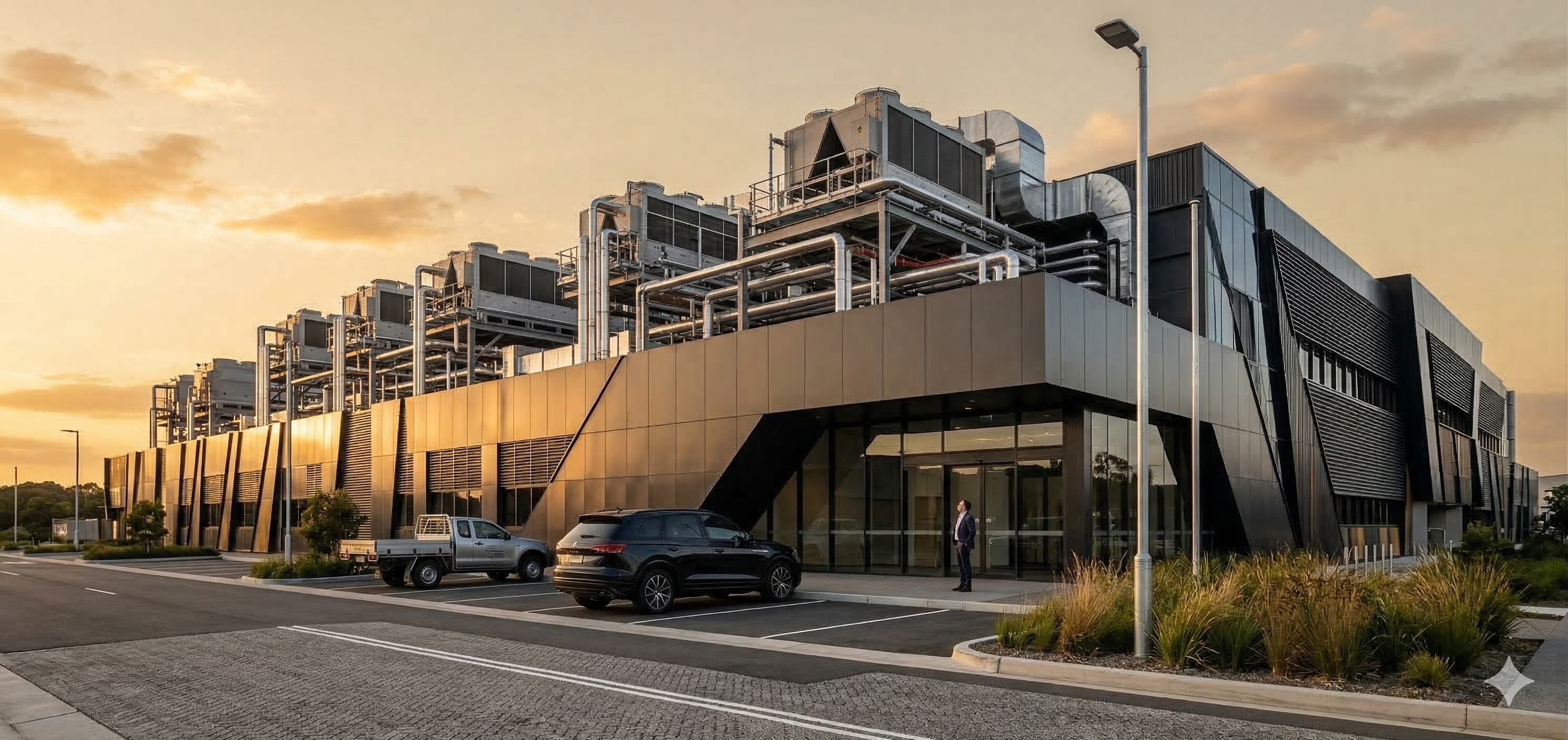
A 250MW AI/data centre conversion of a former heavy industrial site, demonstrating how constrained brownfield land can be repositioned as high-value digital infrastructure.
Project Thesis
Project Forge explores the transformation of underutilised industrial land into a staged 250MW data centre campus. The concept focuses on adaptive reuse, contamination-aware staging, acoustic mitigation, embodied carbon reduction and rapid development repositioning.
This project is aimed at landowners, developers and industrial property groups who may be holding difficult or obsolete land assets with hidden infrastructure value.
Core Problem
Many industrial sites have access, zoning advantages and infrastructure corridors but are seen as compromised due to contamination, outdated buildings, poor public image or fragmented site conditions. The question is:
- Can an underperforming industrial site be converted into a credible AI infrastructure opportunity?
Site Assumptions
Fictional brownfield industrial site.
- Site area: 35–80 hectares
- Target IT load: 250MW
- Existing condition: redundant industrial sheds, hardstand, rail or freight-adjacent land
- Planning context: industrial zoning or employment lands
- Key opportunity: access to power, fibre, roads and existing cleared land
- Key risk: contamination, noise, demolition staging, neighbouring industrial users
Key Constraints
Planning Constraints
- -Existing contamination and remediation requirements
- -Interface with neighbouring industrial lots
- -Heavy vehicle access
- -Retention or demolition of existing structures
- -Fire separation and emergency access
- -Visual upgrade expectations from council or state agencies
Infrastructure Constraints
- -Unknown existing services capacity
- -Need for major electrical upgrade
- -Brownfield civil and drainage complexity
- -Existing easements or buried services
- -Staged demolition and construction logistics
Public/Environmental Constraints
- -Perception of industrial blight
- -Dust, demolition and construction disruption
- -Acoustic spill from new plant
- -Stormwater contamination risk
- -Embodied carbon from demolition
Concept Solution
Project Forge uses a retain, clear and intensify strategy.
Development KPIs
Capacity KPIs
- »Target IT load: 250MW
- »Stage 1: 40MW–80MW
- »Stage 2: 80MW–120MW
- »Future expansion: 50MW–100MW
- »Target use of existing hardstand/access: 30–50% retained where viable
Commercial KPIs
- »Brownfield value uplift
- »Reduced greenfield land acquisition requirement
- »Faster planning narrative if zoning supports industrial use
- »Demonstrable adaptive reuse story
- »Early contamination risk mapping
- »Staged capital exposure
Delivery KPIs
- »Site screen: 2–3 business days
- »Pre-acquisition feasibility: 5–10 business days
- »Brownfield conversion concept: 2–4 weeks
Planning Narrative
The project is framed as the renewal of obsolete industrial land for next-generation digital infrastructure. It supports employment land intensification while reducing pressure on greenfield sites. Planning strengths include: industrial land compatibility, reuse of disturbed land, reduced biodiversity impact compared to greenfield alternatives, potential employment and infrastructure investment, visual and environmental uplift of degraded land. Planning risks include:
- contamination
- acoustic impact
- demolition management
- traffic
- fire and emergency access
- electrical infrastructure upgrades
Sustainability Narrative
The sustainability focus is adaptive reuse and circular infrastructure.
- Retain existing hardstand where appropriate
- Reuse or recycle demolition material
- Minimise new land disturbance
- Remediate contaminated land progressively
- Improve stormwater quality
- Use retained structures for screening where practical
- Plan for efficient equipment replacement
- Reduce embodied carbon compared with full greenfield development
Public Interface Narrative
This project converts obsolete industrial land into cleaner, quieter, better-managed digital infrastructure. The design should show:
- improved streetscape edges
- landscape screening
- reduced industrial clutter
- controlled lighting
- clear truck routes
- acoustic protection
- stronger environmental management